Insurance for East Valley Small Business Owners: A Quick Field Guide by Industry
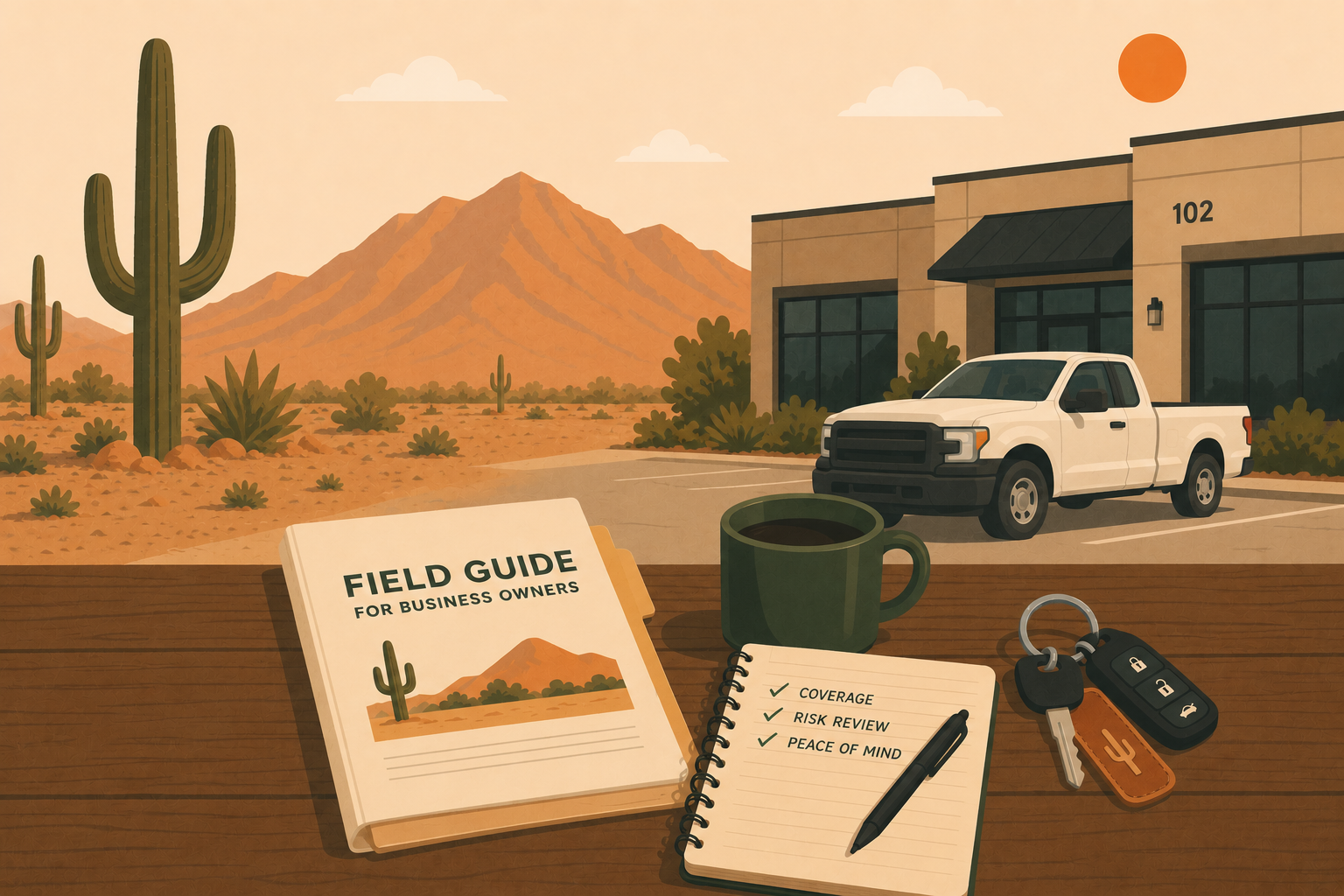
Insurance for East Valley Small Business Owners: A Quick Field Guide by Industry
Reading time: 5 minutes
If you run a small business in Mesa, Gilbert, or Chandler, you already know that insurance isn't one-size-fits-all. A contractor doesn't need the same coverage as a restaurant. A retail shop has different exposures than a home-based consultant.
This piece is a quick reference guide for the most common small business types in the East Valley. Find your industry, get a sense of what coverage typically matters most, and know what to ask about when you're shopping.
The baseline: What every small business needs
Before we get into industry-specific coverage, here's the baseline that applies to almost every small business in Arizona.
General liability. Covers third-party bodily injury and property damage claims from your operations.
Commercial property. Covers your business property, whether you own or lease. Most small business leases require it.
Business Owners Policy (BOP). For most small businesses, general liability and commercial property are bundled into a BOP. Usually cheaper than buying them separately.
Workers' compensation. In Arizona, workers' comp isn't optional if you have employees. According to the Industrial Commission of Arizona (ICA), every Arizona employer with one or more W-2 employees (full-time or part-time) is required to carry it. This is one of the strictest workers' comp thresholds in the country.
Commercial auto. If your business owns or uses vehicles for work, personal auto policies usually exclude business use. You need a commercial auto policy.
Beyond the baseline, coverage needs vary by industry. Here's what to think about depending on what you do.
Contractors and Trades
Contractors and tradespeople are one of the largest small business categories in the East Valley. If that's you, three things typically matter most.
General liability with certificate flexibility. Most job sites will require you to show a certificate of insurance before you can start work. General contractors and property owners will often require you to list them as "additional insured" on your policy for the duration of a project. Prepare for it.
Workers' comp if you have employees. No exceptions in Arizona. If you're a sole proprietor with no employees, you're not required to carry it on yourself, but many contractors elect to anyway because a serious injury without coverage can be financially devastating.
Tools and equipment coverage. Standard commercial property policies may not adequately cover tools transported to job sites. A separate inland marine or tools and equipment endorsement fills that gap.
Real Estate Investors and Property Managers
The East Valley has a large and growing base of real estate investors. If you rent out property, standard homeowners insurance is not enough.
Landlord policies (dwelling fire coverage). The standard for insuring rental properties. Covers the structure, provides liability protection, and often includes loss of rents coverage if the property becomes uninhabitable.
Umbrella coverage. Rental properties add liability exposure. A commercial umbrella provides additional liability coverage above your underlying policy limits, which is worth considering as your portfolio grows.
Short-term rental considerations. If you rent through Airbnb, VRBO, or similar platforms, most standard landlord policies exclude short-term rental activity. You'll need a specialty short-term rental policy or a specific endorsement.
Property manager E&O. If you manage properties for others (not just your own), you may need professional liability coverage in addition to general liability.
Retail and Small Storefronts
Retail businesses in the East Valley range from boutique shops to specialty stores. The core coverage needs are relatively consistent across this category.
BOP is usually the foundation. A Business Owners Policy bundles general liability and commercial property into one package designed for small retailers.
Business income coverage. If your storefront is damaged and you have to close temporarily, business income coverage helps replace lost revenue and cover ongoing expenses like rent.
Cyber liability. If you accept credit card payments, store customer data, or do any online sales, cyber liability is worth considering. Data breach costs are typically excluded from standard BOPs.
Higher product liability limits if applicable. If you sell products with elevated risk (food, cosmetics, children's items, or products with any regulatory exposure), you may need higher limits than a standard BOP provides.
Food Service (Restaurants, Cafes, Food Trucks)
Restaurants and food service businesses have some of the most complex insurance needs of any small business category. Coverage requirements are broader, and exposures are higher.
Liquor liability. If you serve alcohol, most states (including Arizona) require liquor liability coverage as part of your liquor license. Covers claims arising from serving alcohol to patrons who then cause harm. Do not skip this.
Food spoilage and equipment breakdown. If your refrigeration fails or you lose power, food spoilage can cost thousands overnight. Equipment breakdown coverage handles the mechanical or electrical failures that standard property coverage often excludes.
Higher general liability limits. Foodborne illness claims are the food service industry's biggest liability exposure. Make sure your limits are appropriate for the size of your operation.
Food trucks need commercial auto. Mobile food operations need commercial auto in addition to general liability and product liability. The vehicle itself is a rolling business, which changes how it needs to be insured.
Home-Based Businesses
A lot of East Valley small businesses operate out of a home. Consultants, bookkeepers, real estate agents, online sellers, and service providers of all kinds. If that's you, here's what to know.
Your homeowners policy is not enough. Most homeowners policies explicitly exclude business activity. If you run a business out of your home and rely only on your homeowners policy, you may have significant coverage gaps.
Home business endorsement or standalone BOP. Some homeowners carriers offer a home business endorsement for very small operations. If your business is more than incidental (clients visiting, valuable equipment, significant revenue), a standalone BOP is often the better answer.
Professional liability if you provide advice or services. Consultants, coaches, real estate agents, and accountants typically need professional liability (E&O) coverage separately.
Cyber liability for online businesses. If you handle customer data, take online payments, or run an e-commerce operation, cyber liability is worth considering.
The one thing that applies to every business
Coverage needs change as your business grows. Adding an employee triggers workers' comp requirements. Buying a vehicle triggers commercial auto requirements. Growing revenue may require higher liability limits.
An annual insurance review with an agent who understands your business is worth 30 minutes of your time each year.
The bottom line
Small business insurance isn't a checkbox exercise. What you need depends on what you do, who you serve, and how your business operates. The good news is that most of the coverage isn't complicated once someone actually explains it to you.
If you own a small business in the East Valley and want a second opinion on your current coverage (or you're starting a business and want to get insurance right from day one) that's what we're here for. Bring what you have, tell us what you do, and we'll walk you through it.
Steven White
Founder, Switchback Insurance
The local guide that knows the trail
480-916-7291
Steven@SwitchbackAZ.com
Gilbert, AZ 85296
Sources
Industrial Commission of Arizona (ICA). Workers' Compensation Requirements for Arizona Employers. Under Arizona Revised Statutes § 23-901 et seq. https://www.azica.gov/
Arizona Revised Statutes § 23-901. Workers' Compensation Law. Arizona State Legislature. https://www.azleg.gov/arstitle/
U.S. Chamber of Commerce. "A Guide to Choosing the Best Small Business Insurance: Types, Costs, and Coverage." Published April 2026. https://www.uschamber.com/co/run/human-resources/small-business-insurance
Insurance Information Institute (III). "Understanding business owners policies (BOPs)." https://www.iii.org/article/understanding-business-owners-policies-bops